Making the food journey feel effortless.
An end-to-end engagement and retention strategy for Zomato’s Tier-1 city users.
01 / THE PROBLEM
What needed to make more sense?
In a crowded food-delivery market, existing users encounter decision fatigue, checkout friction, and uncertainty around delivery. I examined the full discovery-to-order-to-delivery journey rather than treating each screen as an isolated problem.
02 / DISCOVERY
How I approached it
- Audited eight funnel stages: home, discovery, restaurant page, menu, customization, cart, payment, and tracking.
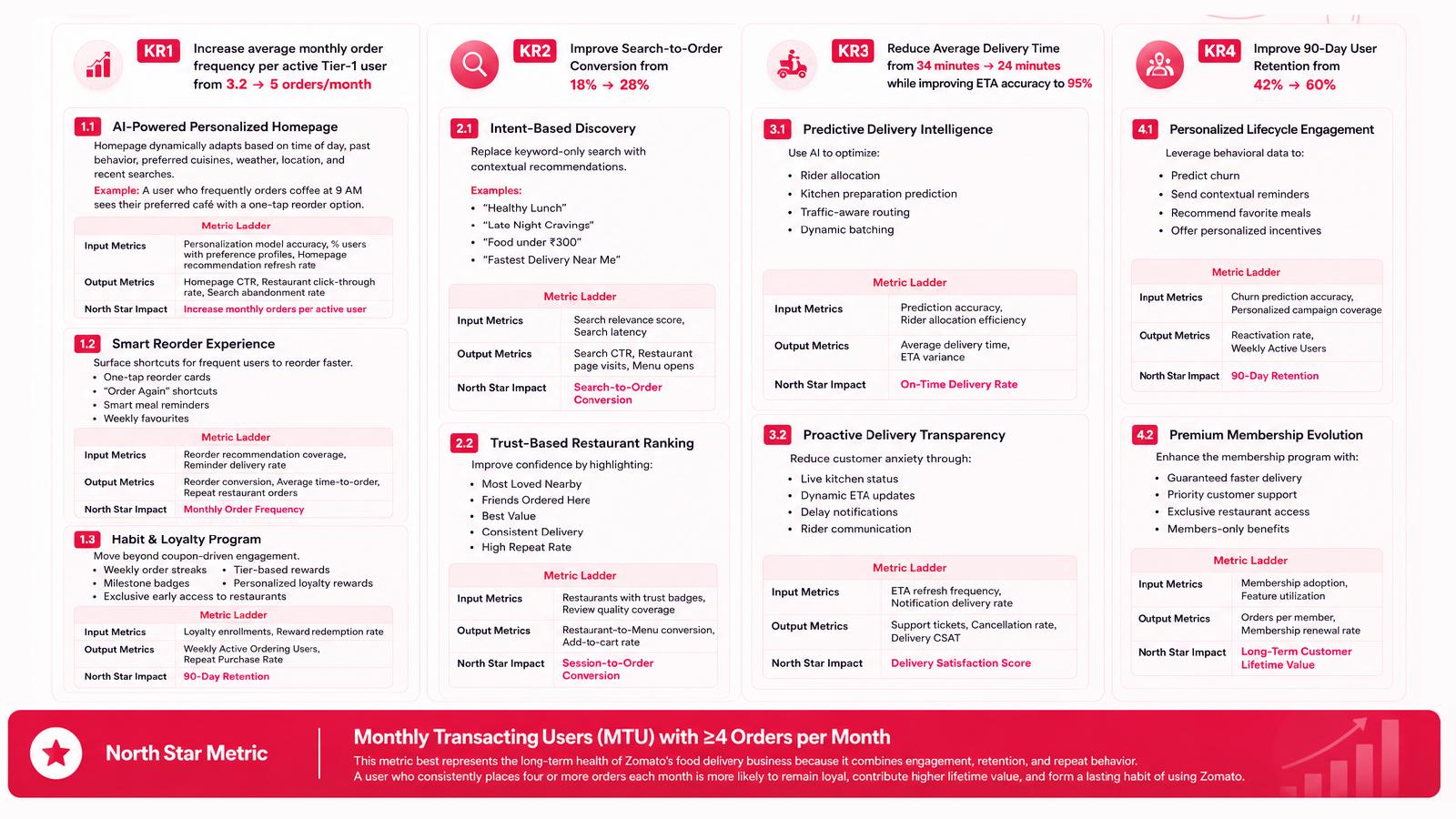
- Mapped the strategy into OKRs, input and output metrics, and cohort analysis.
- Identified promotional clutter, hidden fees, coupon hunting, confusing menus, and changing ETAs as friction points.
03 / PRODUCT DECISIONS
The proposed direction
- Personalized homepage and smart reorder shortcuts for frequent users.
- Intent-based discovery and restaurant ranking that surfaces relevant trust signals.
- Predictive delivery intelligence plus proactive kitchen status, ETA changes, and delay notifications.
- Habit and loyalty programs, personalized lifecycle engagement, and an evolved premium membership.
04 / MEASURES & LIMITS
What success would look like.
The deck defines these figures as strategy targets, not achieved business results. Additional targets include delivery time of 34 → 24 minutes and 95% ETA accuracy. Its north-star measure is monthly transacting users placing at least four orders per month.
05 / THE TAKEAWAY
The thought I’d carry forward.
Reducing decision effort and making delivery predictable should reinforce each other. The strategy links each initiative to a metric ladder so teams can distinguish shipped features from meaningful behavior change.
A closer look at the strategy.
06 / ALL THE DETAILS
The original work, in full.
The complete research, diagrams, screens, and supporting details are in the original document.
If the document preview is unavailable, use “Open the complete case study” above.