A learning journey that keeps up with the child.
Personalized early-math paths that respond to success, struggle, and forgotten concepts.
01 / THE PROBLEM
What needed to make more sense?
Children learn at different speeds. Repetition can bore a confident learner, while a difficult task can frustrate a child who needs support. My journey focuses on ages 5–7 within the broader 4–10 learning-app brief.
02 / DISCOVERY
How I approached it
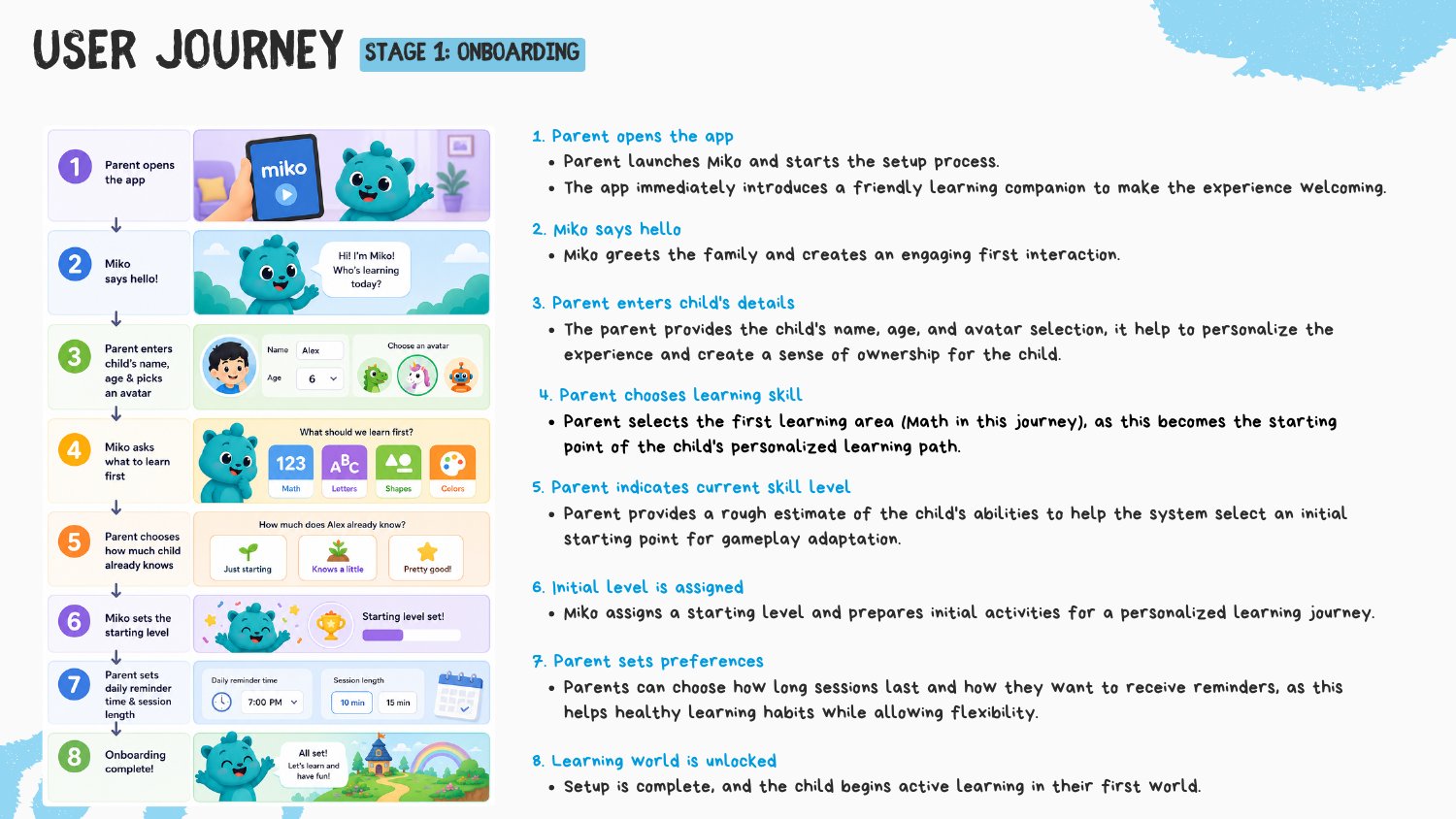
- Mapped a six-stage early-math journey from parent onboarding to rewards and progression.
- Documented objectives, needs, feelings, and barriers at each stage.
- Explored separate success, struggle, and revision paths rather than one sequence for every learner.
03 / PRODUCT DECISIONS
The proposed direction
- Use parent-led setup, a starting skill level, session preferences, and audio-guided first activities.
- Reward success and gradually increase difficulty while varying game mechanics.
- When the child struggles, add hints, demonstrate answers, slow the pace, simplify the activity, or return to a previous level.
- Introduce short revision activities after a 3+ day absence or later signs of weak recall.
- Make progress visible through stars, badges, puzzle pieces, and themed world unlocks.
04 / MEASURES & LIMITS
What success would look like.
The deck defines an adaptive experience and proposed rules; it does not present measured learning or retention gains. Proposed struggle thresholds include support below 40% performance and additional simplification below 20%. These rules need validation with children and parents before production.
05 / THE TAKEAWAY
The thought I’d carry forward.
The experience should protect confidence while adapting difficulty. A child can receive more help and still finish the first session feeling successful.
06 / ALL THE DETAILS
The original work, in full.
The complete research, diagrams, screens, and supporting details are in the original document.
If the document preview is unavailable, use “Open the complete case study” above.