Making the session booking flow easier to trust.
A usability audit of discovery, astrologer profiles, chat initiation, and wallet recharge.
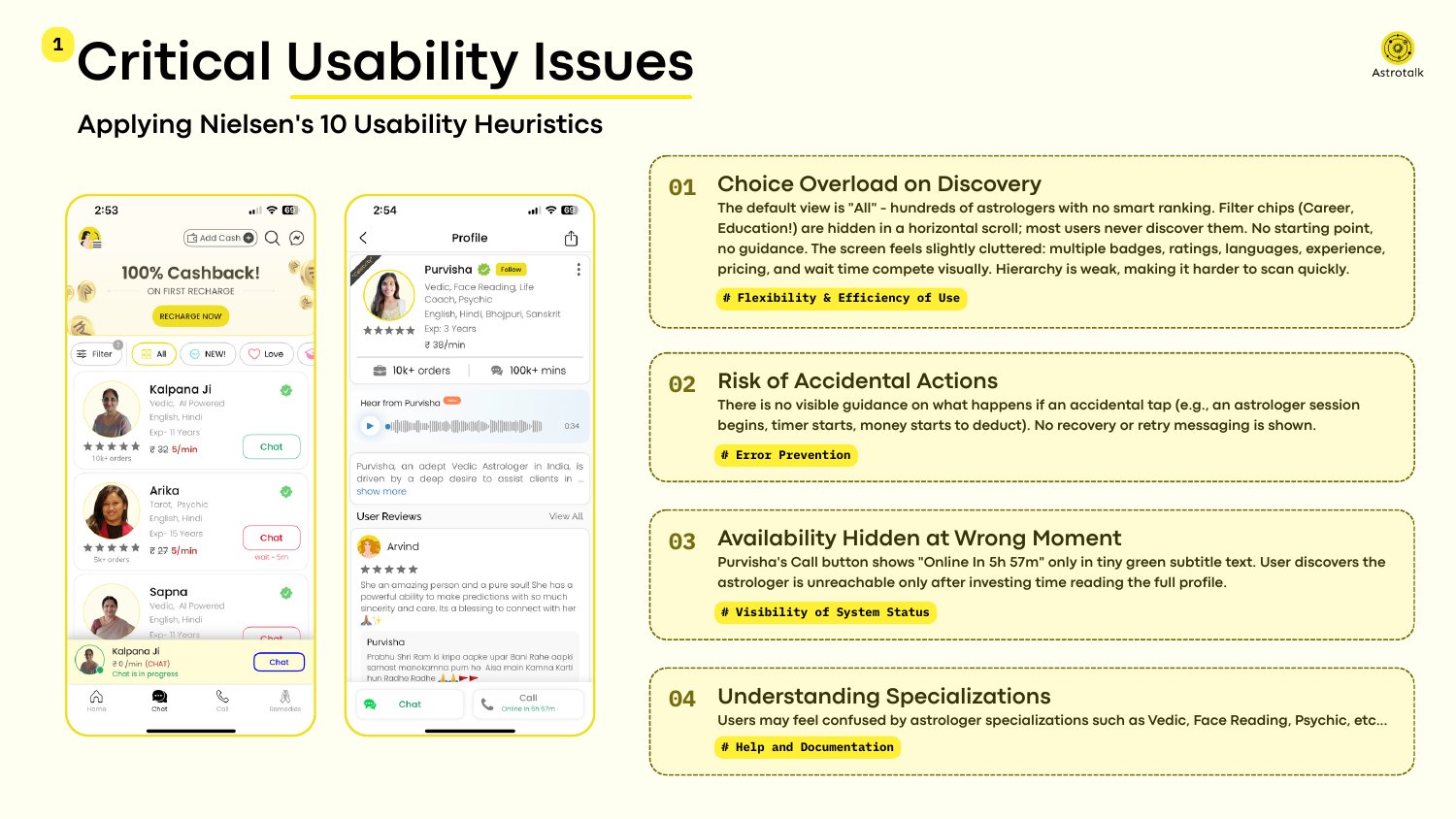
01 / THE PROBLEM
What needed to make more sense?
Booking a consultation is the platform’s monetization loop. Too many similar profiles, unclear availability, ambiguous pricing, and a surprise wallet top-up can interrupt a user who is already trying to make a decision.
02 / DISCOVERY
How I approached it
- Audited four stages: astrologer discovery, profile review, chat initiation, and wallet top-up.
- Identified ten usability issues using Nielsen’s heuristics.
- Applied Hick’s, Fitts’s, Jakob’s, and Miller’s laws to choice overload, tap targets, familiar patterns, and information density.
03 / PRODUCT DECISIONS
The proposed direction
- Surface relevant recommendations, stronger sorting, and availability on listing cards.
- Use “sessions completed” rather than ambiguous “orders” as social proof.
- Standardize per-minute pricing and explain specializations through contextual help.
- Show balance warnings, a five-minute cost estimate, and recharge amounts translated into session duration.
- Add confirmation and recovery feedback around charged actions.
04 / MEASURES & LIMITS
What success would look like.
This is a heuristic review with proposed improvements. It does not claim a measured conversion uplift. Validate the proposals through booking-task usability sessions and a controlled comparison of recharge and chat-initiation completion.
05 / THE TAKEAWAY
The thought I’d carry forward.
Trust is also an interface problem: clearer labels, predictable costs, and visible availability can remove uncertainty at the moment of payment.
06 / ALL THE DETAILS
The original work, in full.
The complete research, diagrams, screens, and supporting details are in the original document.
If the document preview is unavailable, use “Open the complete case study” above.